


How to Teach Macbeth to Various Types Of Learners
Updated: Jun 11, 2024
You can purchase all my lesson plans, slides, worksheets, assessments & more at a discounted price here: Macbeth COMPLETE Bundle - 8-9 week unit! Includes Lesson Plans, Slides & More! (teacherspayteachers.com)
I am, to put it lightly, COMPLETELY OBSESSED with this play! I have taught it inside of a classroom
for 12 years with various learning types (General Ed., Honors, Special Ed. ENL, etc.). My student often asked if I was tired of teaching the same work over and over, but this is one that keeps me intrigued. I have only grown to love it more and wonder more about the characters, Shakespeare's purpose, and connections to other texts and real life events. This is the first year since 2010 I am not teaching this play (with the exception of remote learning/and my pregnancy in the 2020-2021 school year). My goal is to blog as much about my practices & tips and tricks as possible while it is still fresh in my mind so I can share my practices, what has worked, and what hasn't!
Step 1:
Get your hands on AS MANY versions of Macbeth as you possibly can!
My favorite, and main version used in my classroom is Barron's SHAKESPEARE MADE EASY MACBETH. This text has a side by side translation of the original, but in my opinion, is more true to the meaning and keeps a lot of the devices as the original, where as "NO FEAR SHAKESPEARE" by Spark Notes in some scenes, oversimplifies. However, Spark Note's "NO FEAR SHAKESPEARE" is a great supplement for the complicated scene and I often use these to help my ENL and Special Education Students. Their site has the printable side by side version, and the audio included!
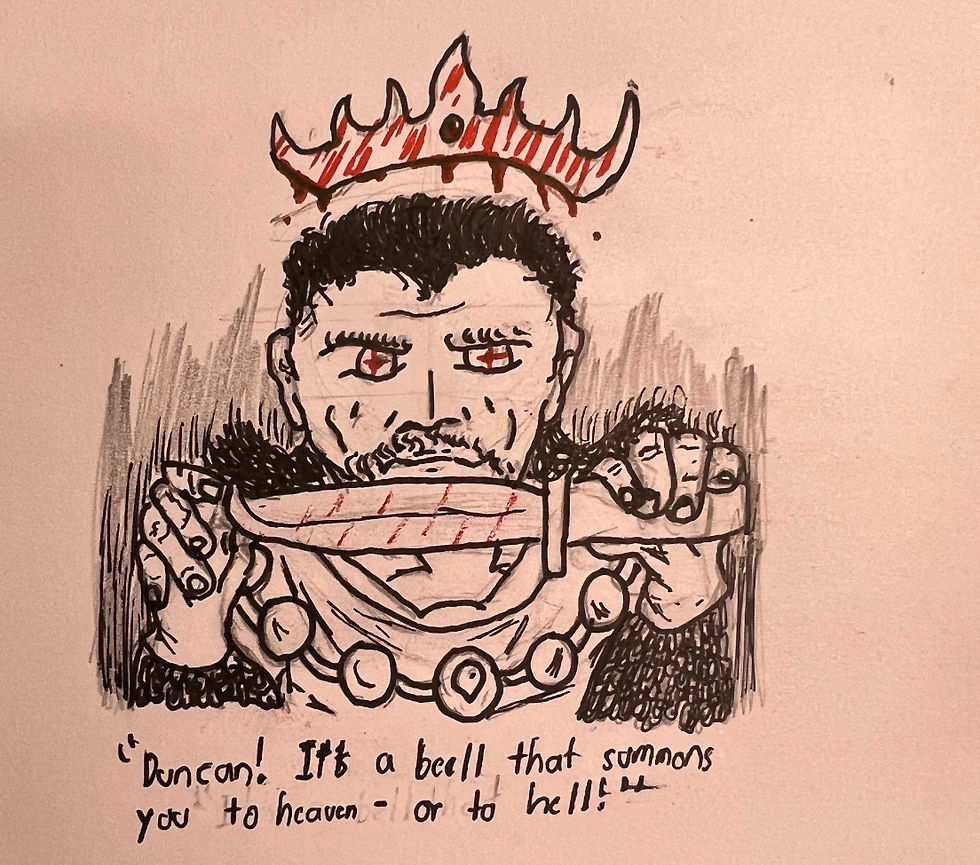
"NO FEAR SHAKESPEARE'S" Graphic Novel for Macbeth has amazing illustrations and the visual learners and ENL students love this! Many times my higher leveled students will ask to take a peak, and they use it to inspire their own illustrations for different projects, which I will get to in a few minutes.

Step 2: Scare your students! I am serious. (Tip: if you notice some are actually and scared and it's concerning to you- you can always tell them privately you were doing this to make the play more exciting... but it's best not to reveal that secret!) I have a giant version of Macbeth that includes an article that explains the "Curse of the Scottish Play" - I cannot share for copyright reasons- but it goes a little something like this:
"ACCIDENTS, INJURIES AND DEATHS - THE CURSE OF MACBETH
According to folklore, Macbeth was cursed from the beginning. A coven of witches objected to Shakespeare using real incantations, so they put a curse on the play.
Legend has it the play’s first performance (around 1606) was riddled with disaster. The actor playing Lady Macbeth died suddenly, so Shakespeare himself had to take on the part. Other rumoured mishaps include real daggers being used in place of stage props for the murder of King Duncan (resulting in the actor’s death).
The play hasn’t had much luck since. The famous Astor Place Riot in New York in 1849, caused by rivalry between American actor Edwin Forrest and English actor William Charles Macready, resulted in at least 20 deaths and over 100 injuries. Both Forrest and Macready were playing Macbeth in opposing productions at the time.
Other productions have been plagued with accidents, including actors falling off the stage, mysterious deaths, and even narrow misses by falling stage weights, as happened to Laurence Olivier at the Old Vic in 1937."
"According to a theatrical superstition, called the Scottish curse, speaking the name Macbeth inside a theatre, other than as called for in the script while rehearsing or performing, will cause disaster."
Cited From: https://en.wikipedia.org/wiki/The_Scottish_play
I then reveal that once we begin reading, Shakespeare will make himself seen. Every time the blinds move, a door opens or a gust of wind appears, in our classroom I remind them of "The Curse" :)
"Shakespeare's Uncovered, Macbeth with Ethan Hawke", talks more about this. If you can purchase this documentary, I would strongly recommend it. I play bits and pieces to aid with comprehension and critical thinking throughout our class reading of the play as we are reading throughout the unit. There is one part I love to play which talks about various ways Lady Macbeth can be played (I purchased my copy off of Amazon! https://www.amazon.com/Shakespeare-Uncovered/dp/B00B8OV81M)
Step 3: Building Confidence & Background Knowledge!
You can purchase my Pre-Reading Gallery Walk Here:
What other educators are saying:


Before jumping into reading such a complex play, it is necessary and completely beneficial to spend a few days indulging in a pre-reading Gallery Walk!
Maybe students have read The Tragedy of Romeo & Juliet or other Shakespearean works, and maybe they haven't. Either way, Shakespeare has a reputation of being difficult to read and intimidating for students and teachers, so it is important to ease students' nerves and build some confidence before diving into the story.
The station titles and topics I like students to explore are:
Station 1: The Structure of a Tragedy
Station 2: Shakespeare's Life
Station 3: Shakespearean Insults
Station 4: Helpful Vocabulary for Reading a Play
Station 5: Major Themes To Expect In Macbeth
Station 6: Meet The Major Characters
Station 7: Anticipation Guide Questions
I print out articles for each of the stations, and students get specific guided questions to answer at each station. They work together in groups, which builds confidence. I play a helpful video at each station to supplement to visual and auditory learners as well as struggling readers and writers.
I usually give about 8-10 minutes at each station, depending on the group of students I have and how well they are working. Every class is different.
If students are finished early, they could generate their own questions to be asked at the station, or they could find more helpful videos or images through their own research at that station.
A focus on Argument Writing:
My students answer an argument essay question at the very end of this unit, where they have a choice to answer ONE of the questions: Is Macbeth a villain or a tragic hero? OR Who should be blamed for the tragedy of Macbeth (Lady Macbeth, the three witches, or Macbeth himself?) I make sure I have both questions printed or written down and completely visible in the room, as well as explaining to them over and over that they should keep both questions in mind throughout each of the 5 acts!
Step 4: Gather props & Start the play:
ACT 1:
If you need lesson plans that are detailed with Learning Objectives, an Aim, Bellringer, Helpful Vocabulary, Student-Centered Learning, Differentiated Instruction & Exit Assessment, these are the plans for you!

Gather Props: With all my full length texts, I strongly believe in props. The sillier, the better. Have students draw each of the characters as we meet them. I one time saw a teacher write "RIP" on a character web, so I did this the last time I taught the play and it was a hit! (Literally!) With a play that has so many characters, it is really important to keep these characters visible.
We act the entire play in class. If students are shy, I will take a role, and my coteacher will too!


Corresponding Slides:
My slides are editable and have just recently been updated to be a bit more aesthetically pleasing!
In Act 1 I have my students:
Watch this Cliff Notes Version of the scene we read, either the day we read it or as a bell-ringer in the following class. https://www.youtube.com/watch?v=zt13FbL1xyw I love how this version lists the act and scene number on each part of the cartoon!
Understand the meaning of "AMBITION", the positive and negative effects and brainstorm ambitious celebrities
Analyze at least movie 5 versions of the witches and have them form their own opinions about what the witches sound like and look life while discusses the meaning of a psychic in today's world and "The power of suggestion" (many Act 1, scene 1 clips are on YouTube!)
Characterize Macbeth- MULTIPLE TIMES. I mean, we are still arguing about whether or not he is a villain (evil all along) or a tragic hero (good guy who turns bad) The second scene is really important to play close attention to when thinking about this question. Did you see how violently he fought in war. Oh, and WHY did he IMMEDIATELY think ghastly thoughts when the witches told him his future? Banquo didn't!!! These are important parts that I highlight and ensure my students are paying attention to.
Act out the play and reread various versions as a supplement to help them answer the post-reading questions - and work collaboratively.
Analyze multiple director's versions of Lady Macbeth
Analyze The Macbeth's relationship... & MORE
Act 2:
If you need detailed lesson plans for Act 2 you can get them here:
What other educators are saying:


This act is a lot of fun! The death of the king, crazy weather, and some drunk servants!
It is important to have students analyze Macbeth's mental state before and after killing King Duncan!
Analyze LM's plan- make predictions about whether or not it will work
The floating dagger scene:
What does this say about Macbeth's character?
Is he imagining it? Did the witches put it there? I make this a very important question because if they claim the witches put it there, then they should be blamed for this murder.
After Macbeth murders the king, he has completely changed. Before this he has killed in war- but now, he is killing a good guy, a "godly king", for his own selfish reasons.
Whether or not he feels guilty about it will reveal if he is a "good guy who did a bad thing" or a complete, evil villain!
It is important in this scene to makearguments about how Macbeth’s character has changed and his relationship with LM has changed once he kills the guards
It is also important to discuss the disordered universe- and emphasize how good of a king, King Duncan was, in order to highlight how serious the murder was!
Act 3:
This is the act that completely changes Macbeth'. It is where Macbeth goes from committing one murder, to numerous murders, including the murder of his very own best friend.
He starts to become suspicious of certain people, he even starts keeping secrets from his wife.
I like spending time discussing the Macbeths' relationship and how it is truly beginning to change in this scene. Why does he begin to keep secrets from her? Is he trying to protect her? Does he simply not need her anymore? Or is he becoming such a cold murderer that he simply does not care about anyone but himself.
Either way- this is important to touch upon, as well as the beginning of their role reversal.
Lady Macbeth's famous quote:
"Nothing's gained, all's lost, when a wish fulfilled brings no contentment. It's better to be the victim than to live in worry on the proceeds of the crime"
Reveals a lot about how she is feeling!
Was she weak all along? Is she feeling guilty? Is she starting to "lose it" due to her husband "keeping her in the dark" about his affairs?
Act 4:
LM is not in this scene- why not?
The witches final appearance- are they in control? Have they been in control this entire play?
Act 5:
What is the cause of Lady Macbeth's downfall?
Will the apparitions come true?
Will Macbeth every realize what he has done?
Have you ever wondered what causes Lady Macbeth to transform from a bold and fearless creature to a person who completely crumbles and deteriorates?I have read this play many times and always assumed that it was due to the guilt that she felt after killing the King.
While teaching this play for the first time post-pandemic, I began looking at it through a different lens. I paid more attention to her relationship with Macbeth, and how he chooses to keep her "in the dark" about his affairs, and isolate her. Why does he do this? Is it to protect her or is it because he simply does not need her anymore. Whatever it is, their relationship has completely transformed. Going from a power couple who communicates and supports one another to completely unengaged has had to have affected her. I thought it would be interesting to compare students' experiences from being isolated during the height of the pandemic and what Lady Macbeth has experienced, and have them decide for themselves. What causes her disastrous downfall?
Post Reading Argument Essay:
You can purchase my Argument Essay Slides here:
Step 1: I give students a choice to respond to
Is Macbeth a tragic hero or a villain?
Who should be blamed for the tragedy of Macbeth?
I then group them according to their question of choice, and allow them to work together to use the play and various articles that I give them to create a t-chart.
Step 2: I have my students write their thesis statements and spend time teaching them in a formulaic way.
Students Theme Posters:




Comments